
Telemachus Now
The Invisible Structures That Hold Civilizations Together

On Friday evening, while wandering through our local Value Village with my daughter, I picked up a thick hardcover book titled Abuse of Power: The New Nixon Tapes.
It was one of those wonderfully improbable thrift-store discoveries that almost seems to choose you.
This has happened often enough over the years that I’ve stopped calling it coincidence. I suspect it has less to do with chance than with attention. The longer you carry a worthwhile question, the more often the world reveals patterns that had been there all along.
The subtitle of that book immediately brought the name Chuck Colson to my mind.
For many readers today, his name may not mean much. But during the 1970s, Colson was one of the most powerful political figures in the United States, serving as special counsel to President Richard Nixon. He was widely known as Nixon’s “hatchet man,” a fiercely loyal adviser whose reputation for political hardball made him one of the most feared operatives in Washington.
The book chronicles one of the defining political crises of the twentieth century that might be worth repeating for my millennial readers.
In June 1972, men connected to Nixon’s re-election campaign were caught breaking into the headquarters of the Democratic National Committee at the Watergate office complex in Washington, D.C.
What began as a bungled burglary soon revealed a much broader pattern of political espionage, abuse of executive power, and attempts to obstruct the investigation. As secret White House recordings came to light, the U.S. House of Representatives began impeachment proceedings against the president. Before the House could vote, Nixon resigned on August 9, 1974—the first, and still the only, American president to resign from office.
Colson was at the centre of that drama. He eventually pleaded guilty to obstruction of justice and served seven months in federal prison.
There, his life began to change.
Following his release, Colson founded Prison Fellowship, which grew into one of the world’s largest prison ministries. He became a prolific author, radio commentator, and public intellectual, writing dozens of books on faith, ethics, and public life.
One of those books—Loving God—indirectly introduced me to a story that has quietly accompanied me for most of my life.
If you’ve ever wondered how a guy ends up writing about the history of human perception and symbolic intelligence from a shed in central Ontario, this is probably where the story begins.
When I was in high school, a youth speaker retold the story of a man Telemachus, derived from Colson’s book. For reasons I couldn’t have explained then—and perhaps still can’t fully explain now—that story lodged itself somewhere deep within my teenage imagination.
Around the same time, I also found myself enrolled in a Grade 12 electronic music class despite having none of the normal prerequisites. I still don’t know what possessed me to sign up. I do remember the teacher announcing that our only assignment would be to write and record an original song.
There was just one small problem.
I had only recently begun teaching myself to play guitar.
At the time, I knew exactly two chords.
It quickly became apparent that I was going to have to learn a third if I hoped to finish the assignment.
So, with the help of a few friends, I did.
And somewhere between sore fingertips, awkward chord changes, and discovering that songs could carry ideas as well as melodies, I recorded a song called Telemachus on a 4-track analog tape recorder I rented from the local music store.
Looking back, it seems like such an improbable choice of subject matter. Adolescence is a season of searching for identity, and our first songs often reflect that—love, loneliness, misunderstanding, and the hope that someone, somewhere, might finally understand us.
Instead, I sang about a fourth-century monk who stepped into an imperial amphitheatre to stop two professional fighters from killing one another.
It’s been a very long time since I busked in the halls of Bowmanville High School, my guitar case open in front of my locker, collecting a few coins and, on at least one occasion, somebody’s discarded tuna sandwich.
More than thirty years later, with a year or so of Greek under my belt, I’m more than a little embarrassed to admit that I mispronounced Telemachus every time I sang it.
But oddly enough, I could still bring it out on stage if I wanted to.
The chords are still there, tucked away somewhere in muscle memory every time I add the sus4 extension to a D chord with my pinky finger.
The name stayed with me too.
Looking back, I think that’s how formation often works. Long before we understand an idea, we rehearse it. We carry it with us—sometimes in our minds, sometimes in our hands—until one day life gives it a meaning we couldn’t possibly have recognized when we first encountered it.
Telemachus turned out to be one of those names.
The Greeks often embedded meaning directly into names. Long before modern psychology spoke of identity, they understood that names could carry aspirations, memories, and stories. That’s one of the earliest forms of symbolic intelligence: using symbols not merely to label reality, but to shape how we understand it.
According to Christian tradition, Saint Telemachus was an eastern monk who travelled west and entered a Roman arena sometime around the beginning of the fifth century. Horrified by the spectacle before him, he stepped between two gladiators and pleaded for the violence to stop. The crowd turned on him and killed him.
The Emperor Honorius, moved by the monk’s martyrdom, shortly thereafter abolished the gladiatorial games.
That story reaches us principally through the church historian Theodoret of Cyrrhus, writing several decades later, and historians continue to debate exactly how the events unfolded. Whether Telemachus’s death directly persuaded Emperor Honorius to abolish the gladiatorial games remains uncertain, but one thing is clear: the gladiator fights were abolished.
And perhaps historical certainty is not the reason the story has endured.
It survives because it asks a timeless question.
What difference can one unarmed person make against the momentum of an entire civilization?
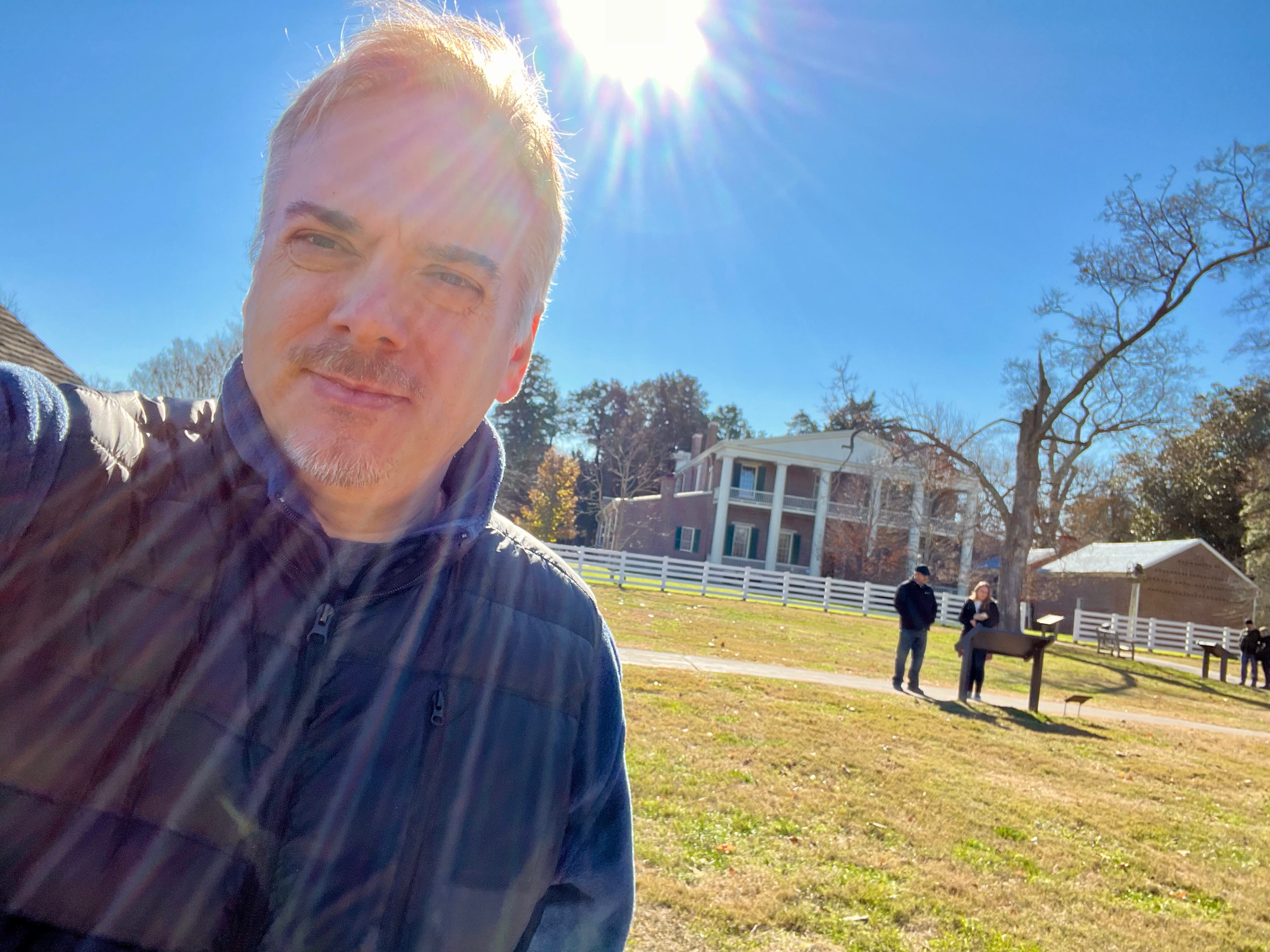
Many years have passed since those hallway performances.
A few years ago I found myself walking through U.S. President Andrew Jackson’s Hermitage outside Nashville, Tennnesee.
As I entered the house, the tour guide drew my attention to the extraordinary French panoramic wallpaper that covered the entrance hall. It depicted scenes from The Adventures of Telemachus by François Fénelon.
I remember doing a double take.
Telemachus?
What connection could a fourth-century Christian monk, remembered for confronting societal violence, possibly have with the home of an American president?
As it turns out, the Telemachus on the walls of the Hermitage was much older. He was the son of Odysseus, the young prince from Homer’s Odyssey, left behind as a child when his father sailed to Troy. By the time Homer begins his story, Telemachus has grown into a young man searching not only for his missing father, but for his own identity.
More than two thousand years later, the French archbishop François Fénelon took Homer’s young prince and reimagined his journey in a remarkable book published in 1699: The Adventures of Telemachus. Written to educate the Duke of Burgundy, grandson of Louis XIV, it transformed an ancient epic into a meditation on political leadership.
In Fénelon’s telling, Telemachus still searches for Odysseus, but each stage of the journey becomes a lesson in what it means to govern wisely.
Power should be restrained.
Kings should be humble.
Prosperity should be shared.
A ruler’s greatness should be measured not by conquest, but by justice.
For more than a century, it became one of the most widely read books in Europe. Statesmen, educators, and future rulers studied it as a guide to moral leadership. By the early nineteenth century, beautifully illustrated editions and panoramic wallpapers based on its scenes adorned homes on both sides of the Atlantic—including Andrew Jackson’s Hermitage.
Only then did I begin to understand why those images surrounded the entrance hall.
The wallpaper wasn’t merely decorative.
It was aspirational.
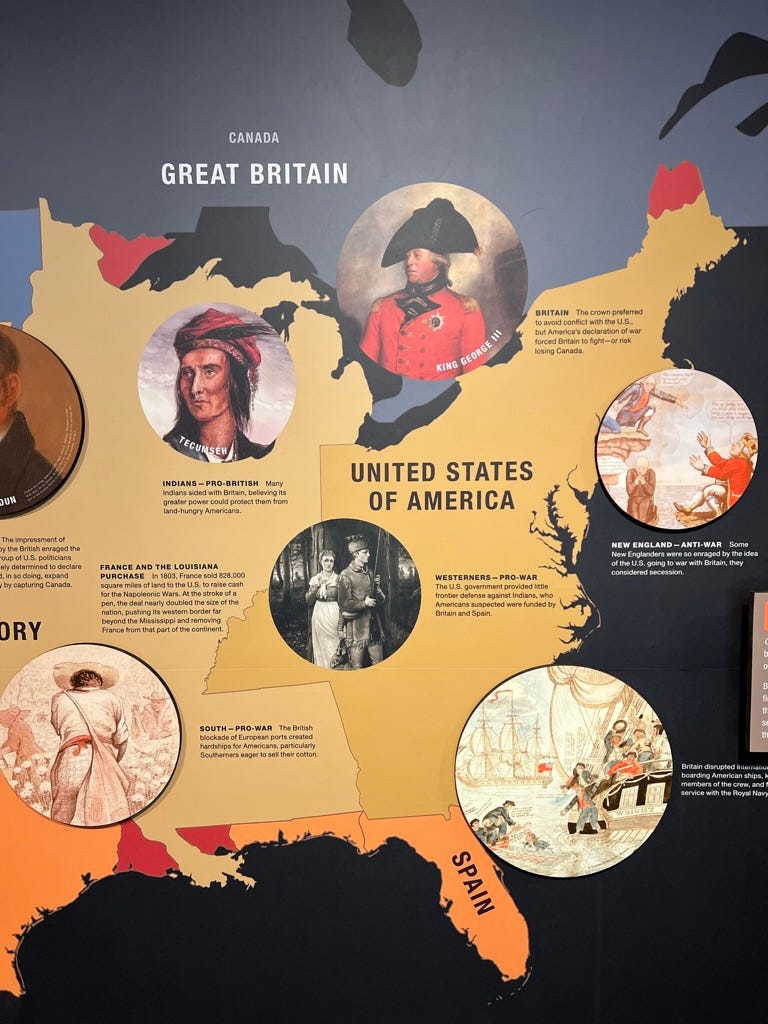
Walking through Jackson’s Hermitage as a Canadian, I found myself noticing things I might have overlooked had I grown up in the American Bible Belt.
Standing in Nashville, I wasn’t simply visiting another country’s history.
I was standing inside a history that both of our countries inherited, even if we remember it differently.
Perhaps that is true of history more generally.
We often imagine there is a single story waiting to be discovered. More often, there are multiple perspectives on the same events. Understanding begins not by choosing one over another, but by widening our field of vision until we can hold them together.
Astronomers call that parallax.
Perhaps historians should too.
It was a quiet reminder that history depends, in part, on where one is standing.
Inside the house, however, my attention shifted from nations to a person.
Andrew Jackson’s life was marked by loss long before he entered the White House. During the American Revolution he lost both of his brothers, and he himself was scarred when a British officer struck him with a sword for refusing to clean the officer’s boots. Long before he exercised power, he had experienced its abuse.
Years later he would endure another devastating loss. I was deeply moved by Jackson’s enduring grief over the death of his wife Rachel. Every room seemed to carry traces of a love interrupted too soon. It was Rachel, I learned, who had chosen the magnificent French wallpaper depicting Telemachus that still surrounds visitors today. She never lived to see Jackson become president or to enjoy the home they had imagined together.
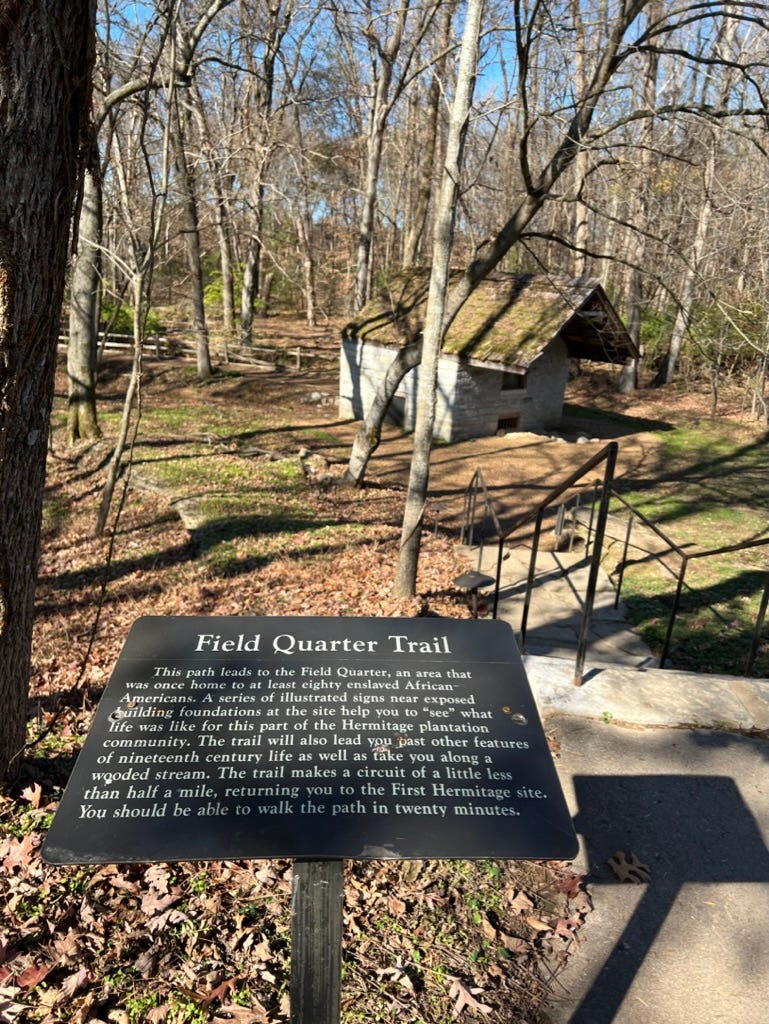
Whatever else history concludes about Andrew Jackson, his sorrow felt unmistakably genuine.
Then I stepped back outside.
The slave cabins still stand on the property.
The grounds also point toward another chapter in American history: Jackson’s presidency and the Indian Removal Act of 1830, whose consequences included the forced displacement of Indigenous nations and the Cherokee Trail of Tears.
The tension was impossible to ignore.
Within the same place I encountered profound personal devotion, enduring grief, aspirations toward wise leadership, and policies whose consequences inflicted immeasurable suffering on others.
I left wondering whether history is best understood not by dividing people into heroes and villains, but by acknowledging that human beings are capable of extraordinary love and extraordinary blindness at the same time.
There is an old saying that hurt people hurt people.
I do not know whether it explains Andrew Jackson.
History is rarely so simple.
But walking through the Hermitage left me wondering how often unhealed wounds—personal, political, or national—shape the decisions that later generations inherit.
Yesterday evening, I watched Christopher Nolan’s new retelling of The Odyssey with my daughter.
I expected to spend the evening thinking about Homer.
Instead, I found myself thinking about the kinds of questions we often ask in the Shed.
Again and again, I find myself drawn to people who revealed realities that cannot be seen directly.
Michael Faraday revealed invisible fields.
James Clerk Maxwell described invisible waves.
Emmy Noether uncovered invisible symmetries.
Walter Schottky exposed invisible boundaries within matter.
Max Planck discovered that energy itself possesses a hidden structure.
Each transformed something unseen into something we could understand.
Watching The Odyssey, it occurred to me that perhaps Homer was doing something remarkably similar.
Not with electricity or mathematics.
With civilization itself.
Long before there were universities or laboratories, Homer was exploring realities that cannot be held in our hands.
Memory.
Trust.
Justice.
Hospitality.
Restraint.
Discernment.
None of these are visible.
Yet remove them, and even the strongest society begins to come apart.
I have often wondered whether the sciences and the humanities have been separated too sharply.
Science reveals the invisible structures of nature.
The humanities reveal the invisible structures of civilization.
Both begin with careful observation.
Both seek patterns hidden beneath appearances.
Both help us perceive realities that shape the world long before we learn how to describe them.
That thought has quietly become one of the guiding convictions behind this substack.
Whether I am writing about semiconductors or medieval monasteries, metadata or Maxwell, crystallography or Homer, artificial intelligence or ancient epics, I find myself returning to the same question:
What are the hidden relationships that allow complex worlds to hold together?
Perhaps that is why these stories continue to find one another.
Perhaps that is why they continue to find me.
As I left the theatre, it occurred to me that although the three Telemachuses who have accompanied me through life are not the same person, they form three notes of a chord I have been hearing—however imperfectly—ever since I learned my third guitar chord in high school.
One challenged a civilization’s appetite for violence.
One became a guide for the education of rulers.
And one inherited a fractured household and slowly learned what it meant to become a man capable of leading it.
Three stories.
Three centuries.
One name that has quietly followed me from a high school to Homer himself.
Some names do not simply appear in our lives.
They accompany us.
Perhaps the best education works that way too.
Not by filling our minds with disconnected facts, but by allowing old questions to return at precisely the moment we are finally ready to hear them.
Thanks for reading Tales from the Shed. If these conversations about science, history, technology, and the humanities resonate with you, consider visiting InfiniteShed.ca and joining the conversation. The best discoveries often begin with questions that quietly refuse to go away.
#TalesFromTheShed #Telemachus #TheOdyssey #Homer #ChuckColson #Watergate #AbuseOfPower #Leadership #History #Civilization #Hospitality #Character #AndrewJackson #ArtificialIntelligence #Humanities #Science #InfiniteShed
I like your thought on historians using the word parallax to describe a widening field of vision. I’m also tempted to read/publish The Adventures of Telemachus now 😊