
The Maps We Inherit
What a dairy cow, an orca whale, and the long human childhood can teach us about conformity—and the difficult freedom of humble uncertainty

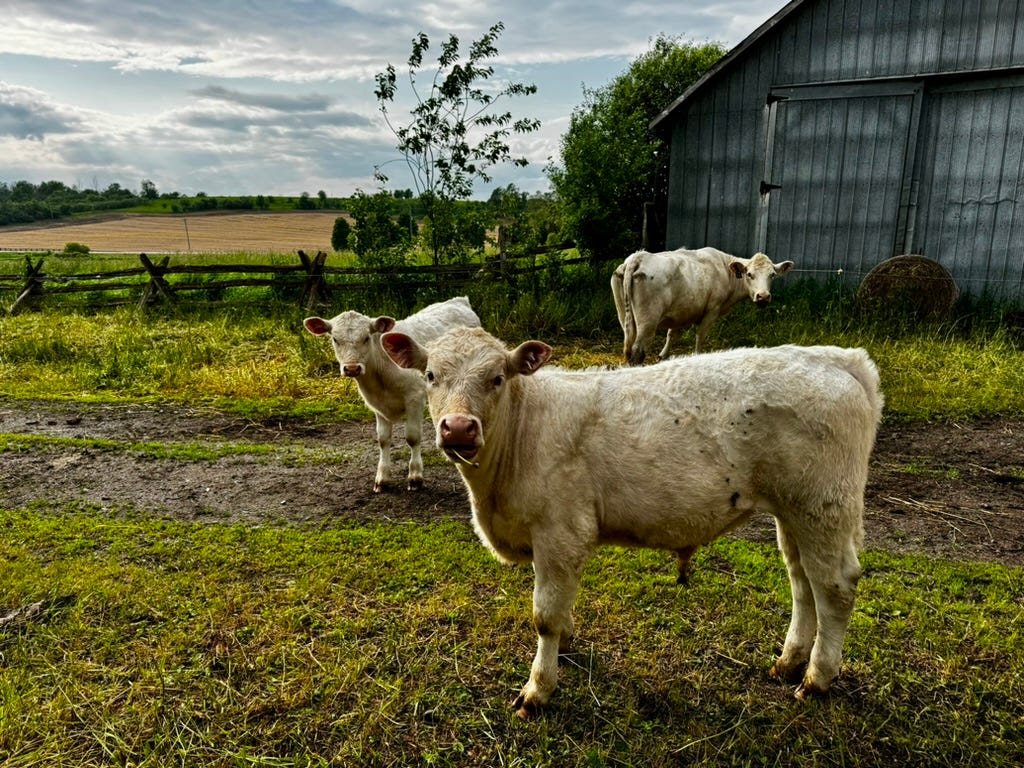
I have spent more time around cows than one might expect of a guy who has worked most of his adult life around books.
This is because my daughter became involved in 4-H a few years ago.
Before that, cattle were simply part of the rural landscape around the Shed—except when they arrived on my plate in the form of a hamburger. Through her involvement in 4-H, I began watching them more closely. I can now tell a polled Hereford from a Charolais, and a Jersey from an Angus.
Occasionally we have also had the opportunity to visit other local farms.
At one highly automated dairy we visited last year, I saw a dairy operation of more seventy cows managed by just two people. A machine swept manure, fans circulated air, automatic dispensers delivered feed, and lasers guided a robotic milking system while computers recorded each animal’s production and measured it against a quota.
Animals, humans and machines moved together inside a carefully designed pattern, though the humans were largely absent.
On the drive home, my daughter asked a question I had not considered: Were cows happier when they were around humans?
Then she began searching on her phone for what was known about their emotional lives.
That experience has been lingering in my brain for nearly a year now, not simply because it is a profound question, but because it disturbed the pattern through which I had been looking at my relationship with other living creatures.
I had been watching the machinery, somewhat disturbed by the displacement of human jobs.
She had been watching the cows themselves.
The animals inside our theories
Across recorded history, animals—and cattle in particular—have helped human beings think about the boundaries of moral life.
In ancient India, especially from the middle of the first millennium BCE, cattle acquired profound practical and sacred significance, while Jain, Buddhist and Hindu traditions developed influential teachings about ahimsa, or nonviolence toward living beings. In the fourth-century before Christ, Aristotle distinguished plants, animals and humans according to their capacities. In seventeenth-century Europe, the French philosopher René Descartes explained animal behaviour mechanically while reserving rational consciousness for humans. In late eighteenth-century England, Jeremy Bentham argued that the morally decisive question was not whether animals could reason or speak, but whether they could suffer.
The cow, then, has never been merely an animal in a pasture. It has also been a creature through which human beings have asked what we owe to lives unlike our own.
Scientific observation continues to reveal memory, emotion, communication, social learning and culture in places where earlier systems left little room for them.
My daughter entered this ancient conversation from a different angle than almost any human before her.
She began with the biological structure of the cow’s brain.
And the more time I’ve spent with her and the cows, the clearer their social world has become in my own thinking. A calf stays attentive to its mother. One animal moves and others follow. The herd has paths, relationships and forms of order that its youngest members gradually learn.
A calf is born into a world already in motion.
Within hours, it can usually stand and soon walk beside its mother. Much of what it needs is carried in its body; other things are learned by remaining close to older animals. Still, they are now largely dependent on humans for survival.
Human beings, by contrast, arrive unusually unfinished compared to any other living things on this planet.
Our period of dependence is exceptionally long and saturated with symbolic instruction. A human child must learn not only where food is found but what counts as food, which sounds belong to language, which gestures communicate respect, which people may be trusted, which places are forbidden and which stories explain the world.
Long before we can examine these instructions, we must conform to them.
Conformity to the human herd is not originally cowardice.
It is a survival mechanism.
Childhood teaches us to associate the inherited pattern with protection and belonging.
That pattern is larger than any individual parent. It has been assembled across generations and contains genuine wisdom. Yet practical knowledge, family anxiety, ancient custom, religious conviction, local prejudice and historical accident arrive woven together.
Necessary rules and arbitrary rules are spoken in the same adult voice.
A parent cannot avoid handing on language, habits, warnings, loyalties and assumptions—some deliberately, others without realizing they are carried.
Creation and the hidden tree
In the relative short period between my birth and my daughter’s, the scientific study of genetics has given us new tools to see relationships that outward appearance previously concealed.
When I was growing up, evolution and creation were still presented in many religious communities as opposing explanations. One was expected to choose between accepting the sacred meaning of life and accepting the biological history of living creatures.
That is no longer an intellectually honest position from my vantage point.
Common descent is not merely a philosophical theory imposed upon nature. Its history is legibly inscribed in the DNA of living creatures. Shared sequences, inherited mutations and genetic structures allow scientists to reconstruct relationships across the tree of life.
Fossils and comparative anatomy anticipated portions of that tree when I was growing up, but molecular genetics allows us to test its branches with a depth and precision unavailable to any previous generation of humans.
The theological meaning of this history remains open to interpretation.
The biological relationship does not.
If you believe in a Creator, this doesn’t diminish the religious significance of the creation, but it does change what an honest doctrine of creation must be willing to contemplate. If the natural world is creation, then its history cannot be protected by refusing to examine the evidence carried within it.
Imagine shrinking yourself down into the DNA of one of your own cells. There, written into its molecular structure, you could look along a corridor of inheritance stretching billions of years into the past—all the way back toward the single-celled organisms from which every animal lineage we know of emerged.
Over the past couple years this has led to many conversations with my daughter about which creatures appeared on this planet first.
The questions sound simple:
The snake or the lizard?
The dinosaur or the bird?
The answers reveal why the tree of life is not a ladder of separate creatures appearing one after another.
Snakes emerged from lizard-like squamate ancestors, although no modern lizard is the ancestor of modern snakes. Birds emerged from within one branch of theropod dinosaurs and remain, in evolutionary terms, living dinosaurs.
An older form does not necessarily disappear when a new branch emerges. Life diverges, adapts and carries its history forward. Nor does outward resemblance always reveal ancestry. A bat and a bird appear to belong to the same world of flight, yet their wings emerged independently at different points in history. As it turns out, a bat is more closely related to a cow—or even a whale—than it is to any bird.
These relationships are not merely conjectural. The history of life is written in our very anatomy.
For those of us who grew up in faith-based communities, this may be a deeper invitation than we wish to accept. Yet it is difficult to avoid without performing a remarkable intellectual contortion: accepting the genetic science that underlies modern medicine while rejecting the evolutionary history written in the very same DNA.
The Predator and the Pasture
At some point during our excursions, it occurred to me that an orca whale and a Jersey cow share a certain resemblance. The thought seemed fanciful at first: one is an apex predator moving through the open ocean; the other, a domesticated animal grazing quietly in a pasture. Yet their resemblance is not merely imagined.
Whales emerged from within the lineage of even-toed hoofed mammals that includes cattle, deer, pigs and hippopotamuses. A cow is more closely related to a whale than to a horse, while the whale’s closest living relatives are hippos. Nature has carried these related animals into radically different forms, but traces of their shared inheritance remain visible if we attend closely enough.
Whales did not descend from modern cows. Both descend from much older common ancestors. While other branches remained terrestrial, the ancestors of whales moved progressively into aquatic environments and were transformed across millions of years.
At one end of this family tree is the orca, an apex predator living in durable, often matrilineal communities.
Pods hunt cooperatively, care for their young and transmit specialized knowledge across generations, including distinctive vocal traditions sometimes called dialects. Whether those systems constitute language in the full human sense remains open to debate, but they are learned forms of communication that help identify families and hold groups together.
The orca’s inheritance is both genetic and cultural.
At the other end are domestic cattle—animals human beings brought inside human settlements and reshaped into sources of labour, milk, leather and beef.
The Jersey represents an especially refined branch of that domestication. It was bred primarily for dairy production: a relatively small body producing milk unusually rich in fat and protein.
One distant descendant of their common lineage became a cooperative hunter of the ocean.
Another was transformed into a familiar source of food.
Yet their kinship remains written inside them.
Who constructed the corridor?
Domestic cattle remain social learners. Domestication did not erase their social world; it placed that world inside ours.
Human beings determined where cattle lived, what they ate and which traits were passed on. The orca’s culture developed largely through the interaction of ocean, prey and pod; the cow’s evolutionary trajectory was redirected toward human requirements.
Neither creature exists without constraints.
Orcas now move through oceans transformed by shipping, noise, pollution and diminished prey. Cattle retain preferences, relationships and forms of agency that domestication has not extinguished.
The revealing question is not whether constraints exist.
It is who constructed them.
Inherited potential unfolds inside a corridor of environmental and social limits. Human domestication altered the corridor around cattle so thoroughly that, across generations, the corridor began to alter the animal.
Human beings did not merely build fences around cattle.
We gradually moved some of those fences inside them.
The invisible fences
Human beings also construct environments that reward some behaviours and discourage others.
Families, schools, religions, employers and states establish corridors made of language, approval, habit and fear.
During childhood we need these structures. The difficulty begins when we mistake the structure that formed us for the structure of reality itself.
Eventually something disturbs the pattern.
We meet people who inherited a different one. A trusted authority proves mistaken. A rule presented as timeless turns out to be scarcely older than our grandparents.
For some people this produces curiosity.
For others, fear.
If the inherited pattern has been experienced as the condition of belonging, questioning it can feel like risking exile.
This may help explain why facts alone so rarely change deeply held beliefs. A belief may be more than a proposition about reality. It may also be a thread connecting a person to family, community, memory and identity.
Some people therefore hold the inherited map more tightly when the territory contradicts it.
Others gradually learn to unfold it on the table.
The difficult freedom
That transition is one of the central tasks of adulthood.
It does not require throwing the inherited map away. Much of it may still be accurate. No person can begin from pure first principles. Language, mathematics, craftsmanship and the conviction that evidence should alter belief are themselves inherited.
But a map is not the landscape it describes.
Every inherited pattern is a human compression of reality. It preserves certain features, leaves others out, guides us through the country in which it was made and may serve poorly in terrain its makers never encountered.
Genetic evidence allowed us to redraw our map of the tree of life by permitting inherited categories to change.
Accepting uncertainty does not mean believing that nothing is true.
It means acting on the best knowledge available while allowing evidence, experience and other minds to correct us.
The question is not whether my daughter inherited a pattern from me.
She already has.
The question is whether I can give her enough of a map to move through the world without teaching her to mistake its lines for the limits of reality.
The calf follows its mother because, for now, following is what survival requires.
The young orca follows its mother through an ocean, learning calls, routes and ways of finding food that no genome could fully specify.
The human child begins by following too.
But if we are fortunate, childhood does not end there.
We begin life inside a world already interpreted for us. Maturity begins when we can examine that interpretation—preserving what remains life-giving, repairing what no longer fits and leaving room for paths our parents could not have seen.
My daughter’s question about the happiness of cows was one of those openings.
I had been looking at an efficient system.
She reminded me to ask what it felt like to live inside it.
Perhaps that is how the inherited map first becomes visible: someone beside us asks a question for which it has no marking.
And perhaps accepting humble uncertainty begins when, instead of silencing the question, we make room on the map.
Rob Clements is a Canadian writer, editor and researcher exploring the intersections of science, history, technology and spirituality. He is the founder of InfiniteShed.ca, where ordinary objects and local landscapes become starting points for larger questions about geometry, constraint and transformation.