

The Workshop of Thought
What an Old Carriage House Taught Me About Where Ideas Come From

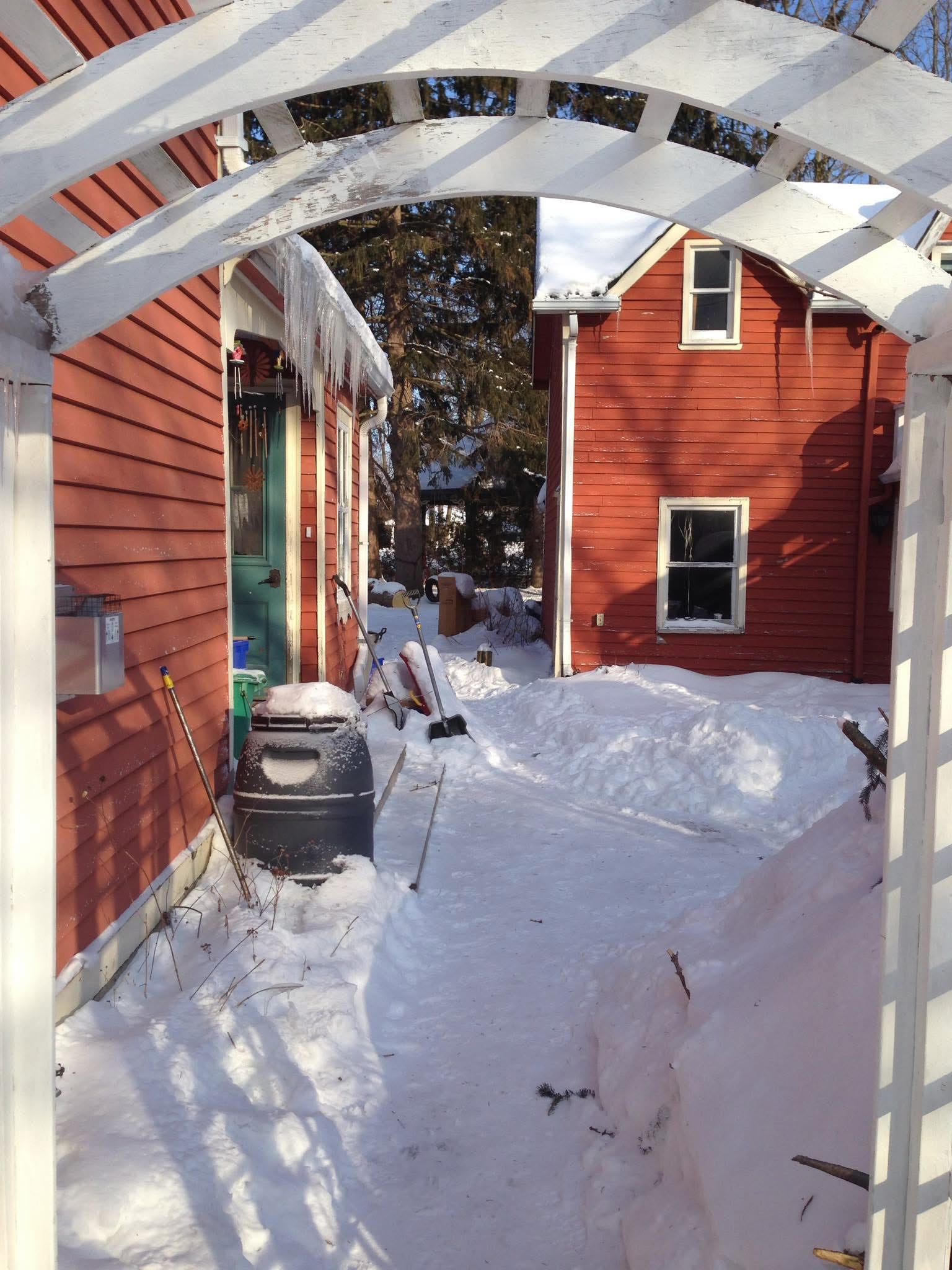
Many years ago, I had a Shed.
It was really a carriage house that stood beside my century home in Orono, Ontario.
The house itself had another story. Built in a nearby village, it was moved to the property in 1901, where it replaced a former blacksmith’s shop. The carriage house belonged to an earlier age, when horses still provided both transportation and power. Two horse stalls remained intact on the ground floor, quiet reminders of the property’s working past.
Between the house and the carriage house was an old well. I never thought much about it at the time, but I often imagined it had once supplied water for both the humans and the horses. Together, the house, the well, and the carriage house formed the remnants of what had once been a small working landscape.
At some point, someone added an addition to the back of the carriage house.
There were no stairs leading to the upper room.
Instead, I climbed a wooden ladder to the loft above the horse stalls and crawled through a small trap door into the addition beyond.
At that stage of life, the house was full.
Four young daughters.
Two dogs.
There was always laughter, conversation, music, barking, or someone looking for Dad.
Like many parents, I occasionally needed somewhere to read, write, and think.
So I climbed the ladder.
This was years before noise-cancelling headphones. Before remote work was understood or socially accepted. Before virtual meetings and carefully curated Zoom backgrounds.
If I wanted uninterrupted time to read, write, or think, I had to create it.
So I climbed the ladder.
It wasn’t elegant.
It wasn’t properly insulated.
In winter my breath lingered in the air.
In summer the heat settled beneath the roof until opening a window became part of the ritual.
But once I pulled myself through the trap door and closed it behind me, something changed.
The sounds of everyday life softened into the distance.
There were books.
A comfortable chair.
A notebook.
Sometimes music.
Often…
just silence.
And for a little while, there was enough quiet to follow a difficult question wherever it wanted to go.
Looking back, I realize the Shed was never remarkable because of its rather unusual architecture.
It was remarkable because of what it permitted.
Years passed.
The red house was sold.
The Shed belonged to someone else.
Life moved on.
Then, a little over a year ago, I stumbled upon a book entitled Moonwalking with Einstein by Joshua Foer.
The book is about memory.
Or so I thought.
As I read, I found myself asking a different question entirely.
Not how memory works.
But how thought works.
Foer describes extraordinary feats of memory built upon carefully constructed mental spaces—memory palaces. I found myself thinking instead about physical spaces.
Libraries.
Studies.
Gardens.
Railway compartments.
Monasteries.
And, unexpectedly…
my old carriage house.
I began to wonder whether ideas require environments just as memories do.
Not magical places.
Simply places where attention can deepen.
That thought stayed with me.
Eventually it became another question.
One that seemed oddly specific at first.
Did Albert Einstein ever work in a shed?
The historical record suggests he did not.
He had a study in Princeton.
Before leaving Germany, he owned a modest wooden summer house at Caputh overlooking the Havel River.
He thought while sailing.
He walked.
He sought refuge from the demands of celebrity whenever he could.
Yet the question refused to disappear.
Because it was never really about Einstein.
It was about something much larger.
How do we create the conditions in which ideas emerge?
The history of science is often celebrates discoveries.
Isaac Newton.
Charles Darwin.
Niels Bohr.
Albert Einstein.
We remember the answers.
Less often do we remember the conditions that made those answers possible.
Newton returned to Woolsthorpe Manor during the plague years after Cambridge temporarily closed. Whether or not every famous story from those years has been embellished, there is little doubt that isolation became one of the most productive periods of his life.
Darwin had Down House and the Sandwalk, where he walked the same circuit while thinking through difficult problems.
Bohr preferred conversations that escaped the lecture hall and continued on walks, train journeys, and long evenings with colleagues.
Einstein found refuge in his Princeton study, his summer house at Caputh, and the quiet rhythm of sailing.
The pattern repeats often enough that it no longer feels accidental.
Great ideas rarely emerge from constant interruption.
We live in an age that celebrates productivity.
The great thinkers rarely did.
Instead, they cultivated availability.
Availability to uncertainty.
Availability to difficult questions.
Availability to changing their minds.
Silence possesses no mystical power.
But it does lengthen attention.
And attention, sustained over time, allows understanding to deepen.
Over the years, I have come to realize that the Shed was never simply a place.
It was a practice.
Sometimes it was that old carriage house in Orono.
Sometimes it was a screened-in porch overlooking a lake in the Kawarthas.
Sometimes it was a railway car crossing northern England on my way to the John Rylands Library in Manchester.
Sometimes it was a quiet corner of a university library in Toronto where the only sound was the turning of pages.
The location changed.
The function never did.
The Shed is whatever place allows curiosity and wonder to remain with a question long enough for understanding to catch up.
This makes me wonder whether every generation builds its own workshop of thought.
A monastery cell.
A library alcove.
A railway compartment.
A sailboat.
A garden path.
A mountain cabin.
A laboratory after everyone else has gone home.
The architecture hardly matters.
What matters is what the place protects.
The blacksmith who once worked that property in Orono shaped iron.
The people who cared for the horses sustained the work that carried others from place to place.
The carpenter who moved an entire house onto that site in 1901 gave it another life.
Someone else, the former mayor of Orono, built the addition at the back of the carriage house.
Years later, I climbed through the trap door into that same addition to shape something less tangible.
Not iron.
Not timber.
Ideas.
The work changed.
The workshop did not.
History so often remembers the discovery while overlooking the places—and the people—that made it possible.
Perhaps that is the real lesson of the Shed.
It was never an escape from the world.
It was a place to pay closer attention to it.
The building was incidental.
The permission to think was not.
Rob Clements (PhD) is an independent Canadian researcher and writer whose work explores the history of science, artificial intelligence, and computing through archival research, travel, and lived experience.
You made me think about Alice Munro's workspace... a small room with a desk made from a piece of plywood. Later she worked in her dining room in Clinton, Ont., which apparently provided her with enough privacy.