
Who Guards the Words?
The struggle over Shira Perlmutter and the institution that will help decide what artificial intelligence may take from us

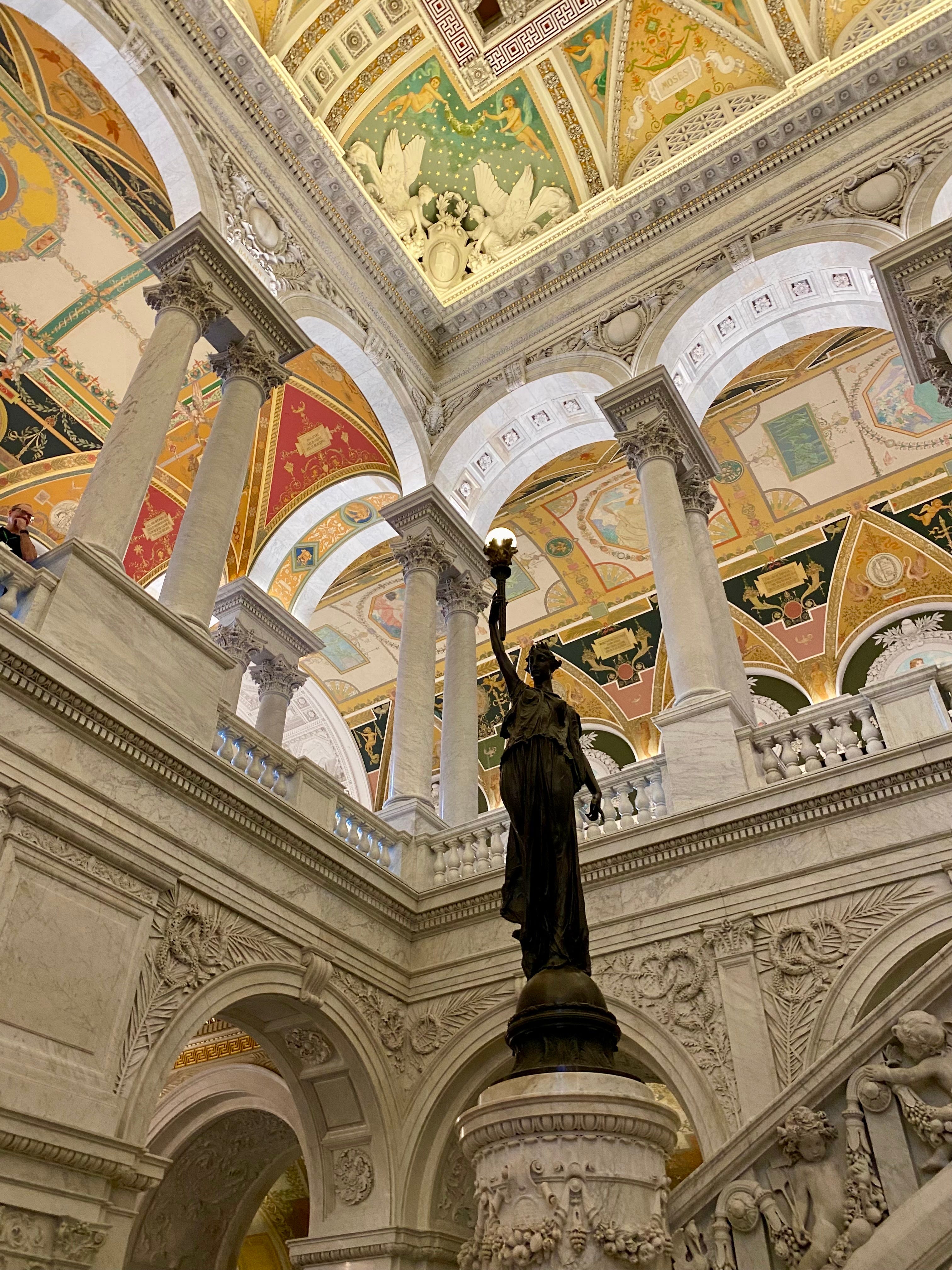
Across the street from Capitol Hill in Washington, DC, stands a cathedral of books called the Library of Congress.
It was established in 1800 to serve the nation’s legislators, but it has grown into something larger: a repository of human memory from across the planet containing books, manuscripts, maps, music, photographs, films and recordings gathered across generations.
Inside that cathedral is an office responsible for maintaining the public record of copyright claims and advising Congress where the boundaries of copying should lie.
The United States Copyright Office registers claims relating to books, music, photographs, films, computer programs and other works of human imagination. It administers parts of copyright law and helps maintain the narrow corridor between private ownership and public knowledge.
That corridor has always been difficult to guard.
Copyright grants authors a temporary right to control their work, yet it does so for an expressly public purpose: to encourage the creation and circulation of knowledge. Too little protection and the creator cannot live by the work. Too much protection and culture becomes a locked room.
For more than a century, the Copyright Office has worked inside that tension.
Now the room itself is being rearranged.
At its centre stands Shira Perlmutter, the Register of Copyrights and director of the Copyright Office.
Perlmutter was appointed in 2020 by Librarian of Congress Carla Hayden. Under her leadership, the office continued a long-overdue modernization of its systems and undertook an extensive examination of copyright and artificial intelligence.
The prepublication version of the third part of that examination considered one of the defining legal questions of our time:
May an artificial-intelligence company copy millions of books, articles, photographs and other protected works to train a commercial system without first obtaining permission from the people who created them?
The Copyright Office did not offer a simple universal answer. Fair use in American law depends upon circumstances. Some forms of research or analysis may qualify. Others may not.
But the report drew an important boundary.
When copyrighted works are collected at enormous scale to create expressive material that competes with those same works—particularly when the source material has been obtained illegally—the claim of fair use becomes considerably weaker.
That conclusion did not forbid artificial intelligence.
It insisted that technological ambition did not make copyright disappear.
The Copyright Office released the report on May 9, 2025.
The following day, President Donald Trump purported to remove Perlmutter from office. This came shortly after the dismissal of Carla Hayden, the Librarian who had appointed her.
The timing does not, by itself, prove the motive.
But it makes the institutional question impossible to avoid.
Perlmutter sued to retain her position. Her argument was straightforward: the law gives the Librarian of Congress the authority to appoint the Register of Copyrights. The president therefore cannot simply reach into the Library, remove the Register and install someone else.
The administration offered a different interpretation. Although the Copyright Office sits within the Library of Congress, it argued, the Register performs significant executive functions. The president must consequently possess the constitutional power to remove her.
In September 2025, the United States Court of Appeals for the District of Columbia Circuit temporarily sided with Perlmutter. It concluded that the president likely lacked the authority to dismiss an officer appointed and supervised by the Librarian of Congress, and ordered the administration not to obstruct Perlmutter from doing her work.
In June 2026, the Supreme Court declined to lift that order. This was not a final judgment on the constitutional merits of the case. It left the lower-court protection in place while the litigation continued—and left Perlmutter at her desk.
A separate Supreme Court ruling has now complicated the matter.
In Trump v. Slaughter, the Court recognized broad presidential authority to remove officials exercising executive power. Administration lawyers argue that the same principle applies to the Register of Copyrights.
Perlmutter’s lawyers answer that the cases are fundamentally different. The Federal Trade Commission belongs to the executive branch. The Library of Congress does not. The Register is appointed and supervised by the Librarian, not by the president.
Beneath the legal arguments lies a much older question.
Who guards the boundary?
The administration’s 2025 AI Action Plan presented artificial intelligence as a race the United States must win, principally against China. Its emphasis was speed, infrastructure and national power. Copyright was not mentioned.
The Copyright Office’s report looked at the same technology from another direction. It asked what happens to the people whose books, music, photographs, illustrations and computer code provide the material from which these systems learn.
One document saw a race.
The other saw the people beneath the wheels.
The question is not whether artificial intelligence should be developed. It will be developed. Nor is it whether machines may learn from human culture. Human beings have always learned from one another.
The question is whether learning and industrial extraction are the same thing.
A person may read a thousand books across a lifetime. A corporation can ingest millions in a month, preserve their statistical relationships inside a commercial system and sell instantaneous approximations of the labour that produced them.
Scale changes the moral geometry.
A stream may borrow water from the ground without exhausting it.
A pumping station can empty the aquifer.
The distinction matters because copyright is not simply a mechanism for restricting circulation. It is one of the constraints that makes sustained creative work possible. It gives a writer, photographer, composer or illustrator some limited ability to say:
This work passed through my hands.
It cost something to make.
You may not take all of it merely because your machine is capable of doing so.
Congress may soon redraw the institution responsible for protecting that boundary.
On June 8, 2026, the House of Representatives passed H.R. 6028, the Legislative Branch Agencies Clarification Act, by voice vote and sent it to the Senate.
Among other changes, the bill would remove the Copyright Office from the Librarian’s supervision and make the Register a presidential nominee subject to Senate confirmation. At the time of writing, the bill has not become law.
There may be reasonable arguments for modernizing the office’s structure. But placing the Register more directly within presidential appointment politics would not make copyright administration less political.
It would change where the political pressure is applied.
The Library of Congress is not a perfect shelter. No institution is.
But a library begins with a particular understanding of civilization. It collects what human beings have made, preserves it across generations and tries to keep it available for those who come after us.
Its purpose is not to win a race.
Its purpose is to remember.
That makes the connection between the Library and the Copyright Office more than an administrative arrangement.
One institution preserves the record of human expression.
The other protects the conditions under which people may continue contributing to it.
Artificial intelligence has made the production of language, pictures, music and code astonishingly inexpensive. It has not made attention, experience, judgment or truth inexpensive. Those remain costly. They are carried by particular people through particular lives.
The battle over Shira Perlmutter is therefore not merely a personnel dispute in Washington. It is not even solely a dispute about the constitutional limits of presidential power.
It is a struggle over the institutional boundary between memory and appetite.
A machine can consume nearly everything we have written.
A corporation can call that consumption innovation.
A government can call it a national race.
But someone must still be permitted to ask what was taken, who paid for its creation and what will remain possible for the next person who sits down to write.
The future of human authorship may depend upon the survival of that question.
Selected Reading
United States Copyright Office. Copyright and Artificial Intelligence, Part 3: Generative AI Training. Prepublication version, May 2025.
United States Court of Appeals for the District of Columbia Circuit. Perlmutter v. Blanche, No. 25-5285. Order granting injunction pending appeal, September 10, 2025.
Supreme Court of the United States. Blanche v. Perlmutter, No. 25A478. Emergency-application docket.
The White House. Winning the Race: America’s AI Action Plan. July 23, 2025.
United States Copyright Office. Legislative Developments: H.R. 6028.
Andrew Richard Albanese. “Legal Battle over Trump’s Firing of Copyright Chief Shira Perlmutter Heats Up Again.” August 2026.
#ArtificialIntelligence #Copyright #AuthorsRights #Publishing #Books #Libraries #ShiraPerlmutter #LibraryOfCongress #CreativeWork #FairUse #AI #InfiniteShed #TalesFromTheShed